


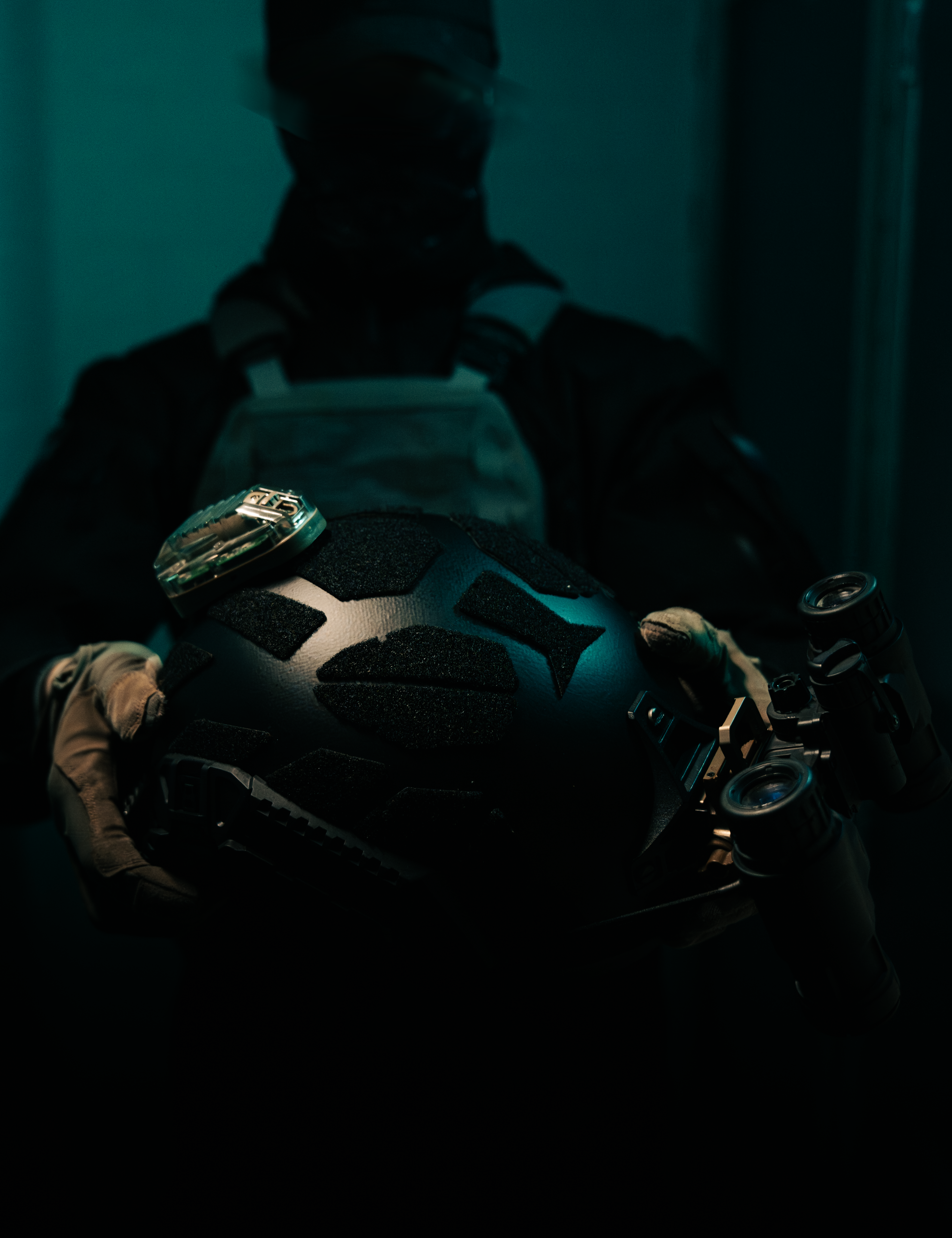
The NIJ 0106.01 standard defines performance requirements and test methods for ballistic helmets designed to protect against handgun threats.
The standard is intended for law enforcement and similar use cases where consistent and verifiable protection is required. It focuses only on ballistic resistance and does not include face shields or rifle threats.
Classification
Ballistic helmets are divided into three types based on the level of protection.
| Type | Description |
|---|---|
| Type I | Protection against lower-energy handgun rounds such as .22 LR and .38 Special |
| Type II-A | Protection against 9mm and lower velocity .357 Magnum |
| Type II | Protection against higher velocity 9mm and .357 Magnum |
The classification is based on specific ammunition and defined impact velocities.
General Requirements
Before ballistic testing, helmets must meet basic construction requirements:
- No internal protrusions
- No holes or openings
- No visible defects such as cracks or dents
- Proper overall workmanship
Each helmet must be labeled with:
- Manufacturer
- Helmet type
- Size
- Date of manufacture
- Lot number
Ballistic Performance
Penetration
Helmets are tested for resistance to penetration using multiple shots at different locations.
A witness plate is placed behind the helmet. If any part of the bullet or fragments passes through and perforates this plate, it is considered penetration.
Requirement: no penetration is allowed for any valid hit.
Impact attenuation
Even without penetration, the impact force must be limited.
This is measured using an instrumented headform that records acceleration during impact.
Requirement: peak acceleration may not exceed 400 G.
Test Conditions
Testing is conducted under controlled conditions:
- Defined ammunition per helmet type
- Specified velocity ranges
- Fixed test setup and alignment
- Multiple impact locations (front, back, sides)
A valid hit must be within a limited angle and properly spaced from edges and other impacts.
Helmets are also tested after environmental exposure, such as water immersion.
Test Ammunition Summary
| Type | Ammunition | Velocity |
|---|---|---|
| Type I | .22 LR, .38 Special | approx. 259–320 m/s |
| Type II-A | 9mm FMJ, .357 Magnum | approx. 332–381 m/s |
| Type II | 9mm FMJ, .357 Magnum | approx. 358–425 m/s |
Each helmet is subjected to multiple impacts.
Limitations
The NIJ 0106.01 standard:
- Applies only to handgun threats
- Does not cover rifle rounds or armor-piercing ammunition
- Does not represent all real-world conditions
It provides a baseline for ballistic performance under controlled testing.
Conclusion
The NIJ 0106.01 standard defines clear requirements for ballistic helmets in terms of classification, testing, and performance.
Compliance indicates that a helmet has been tested against specified handgun threats and meets defined pass/fail criteria.
Share:
Why is the ACH still such a widely used ballistic helmet platform?