

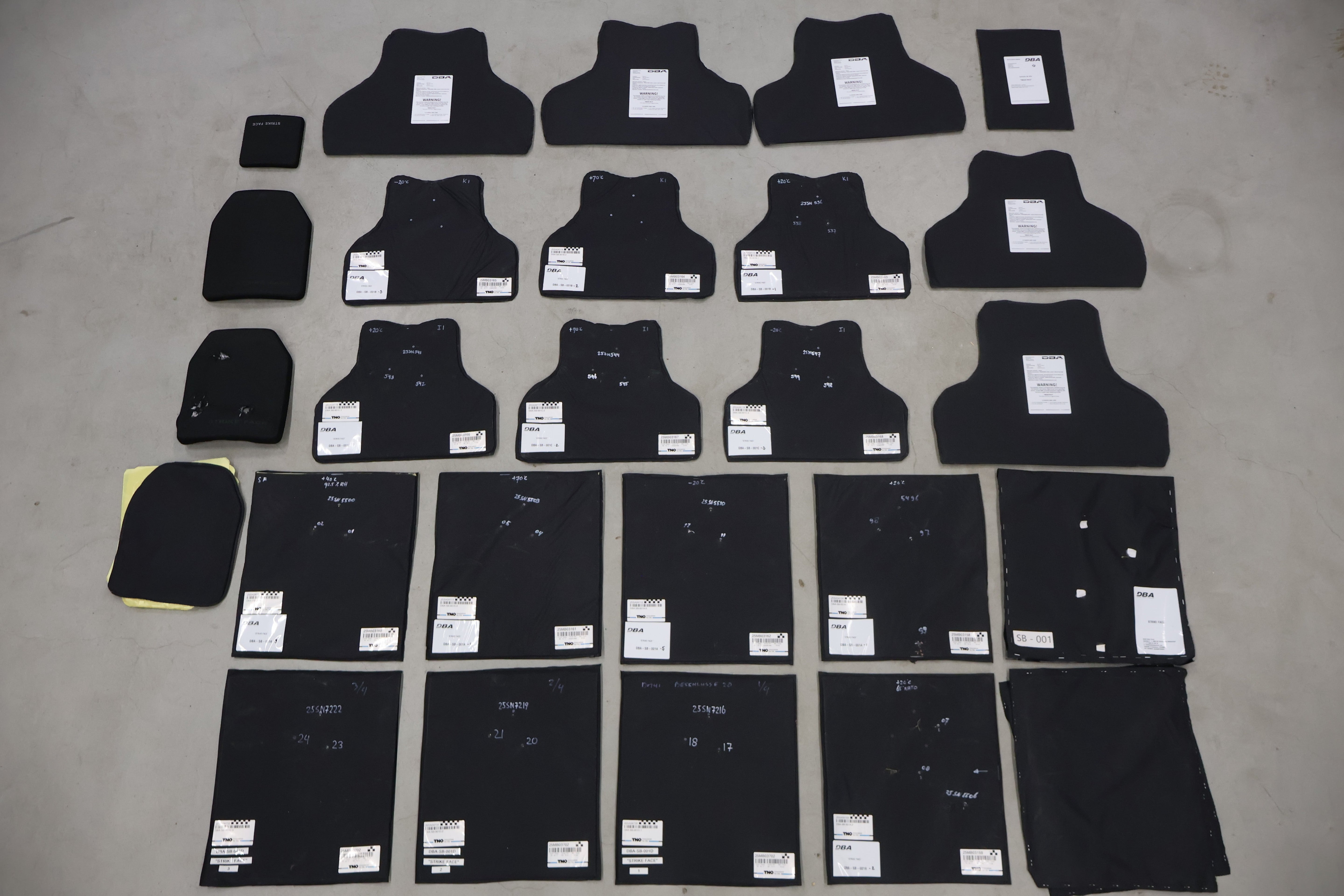
The image above shows a number of soft armor panels and hard armor plates after ballistic testing. These components are part of an ongoing test program focused on verifying ballistic performance under controlled and standardized conditions.
Ballistic testing is a critical element in the development of personal protective equipment. It provides objective data on how armor systems respond when exposed to specific ballistic threats and whether they meet defined performance requirements.
What ballistic testing verifies
Ballistic armor is designed to stop projectiles and manage the energy generated by impact. Testing determines whether this function is achieved by measuring factors such as projectile penetration, material failure, and backface deformation.
Through live-fire testing, it becomes possible to:
-
verify ballistic resistance against defined threat levels
-
measure deformation on the rear side of the armor
-
assess consistency across multiple samples
-
confirm compliance with applicable standards
These results form the technical basis for validation and certification.
Independent testing at TNO
All testing shown was conducted at TNO, the Netherlands’ leading defence and safety research institute. TNO operates as an independent laboratory with internationally recognized expertise in ballistic testing and materials analysis.
Testing at an independent laboratory ensures that standardized procedures are followed, that calibrated equipment is used, and that results are recorded and reported objectively. This approach supports transparency and allows test outcomes to be evaluated against clearly defined criteria.
The role of European VPAM standards
For ballistic armor intended for use in Europe, VPAM standards are an important reference. VPAM defines threat types, ammunition specifications, shot placement, velocities, and environmental conditioning requirements.
These standards are widely applied by European law enforcement and security organizations and provide a consistent framework for evaluating ballistic performance in a European operational context.
Testing scope and conditions
Ballistic testing typically involves more than a single impact. Depending on the applicable standard, armor panels and plates may be subjected to multiple impacts on a single sample, including defined shot spacing and edge or near-edge impact locations.
Environmental conditioning may also be applied prior to testing, such as exposure to heat or moisture, to assess material behavior under specified conditions. Backface deformation is measured to evaluate energy transfer through the armor system.
All test parameters are defined by the relevant test protocols and standards.


Initial test results
The test results received represent the first completed test series within the current development phase. These results provide quantitative data on ballistic resistance and deformation behavior for the tested configurations.
The data is reviewed to determine compliance with applicable requirements and to support further development and certification steps.
Ongoing validation
Ballistic testing is typically performed at multiple stages during the lifecycle of an armor system. This may include testing during development, prior to certification, and during production to verify consistency across batches.
Regular testing helps ensure that materials and manufacturing processes remain aligned with defined specifications.
Share:
Understanding VPAM Protection Levels
Why We Test Our Body Armor at TNO